Know what broke.
Open-source observability for small teams. Nexovue watches your traces, logs, metrics and real users, then tells you in one sentence what went wrong and why.
Break something. See what Nexovue says.
Checkout is 4× slower than normal since 15:04.
Likely cause: deploy a41f2c9 added a query with no index on orders.user_id.
Add an index on orders.user_id. Draft pull request ready for your review.
One place to look.
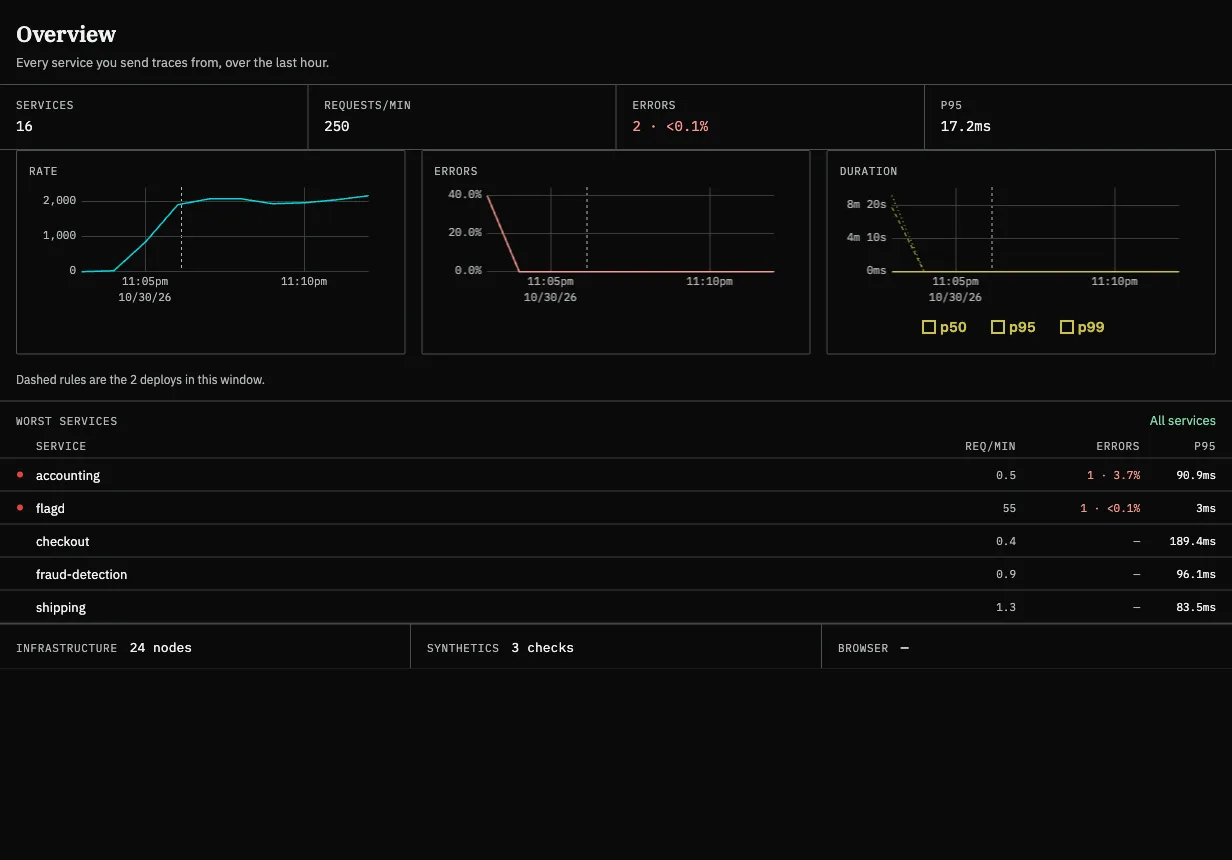
From spike to fix.
Most tools stop at a graph and leave the rest to you. Nexovue carries one problem all the way through, from the first odd minute to the pull request that ends it.
It notices first
A service gets slower, fails more or loses traffic against its own daily and weekly normal. You set no thresholds, and new or quiet services stay quiet.
- p95, /checkout
- 2.1 s
- Normal, Tuesday 15:00
- 520 ms
- Sustained for
- 4 min
It says why
It joins deploys, errors and dependencies into one plain finding. Every claim links to the trace or log behind it, and a cause is called likely until it's proven.
Checkout is 4× slower than normal since 15:04.
- Started 90 seconds after deploy a41f2c9
- Slow span: one query on orders, scanning every row
It opens the case
The finding becomes a case with a timeline, kept in sync with GitHub Issues and Jira, so the work stays where your team already is.
Case: slow checkout
- 15:05 Opened from the finding
- 15:06 Issue created in GitHub
- 15:11 Assigned to the payments team
It tells your team
Email, Slack, Teams, Discord, PagerDuty or a webhook, straight away. An alert never waits for AI, and a guard stops one bad hour becoming a hundred messages.
#payments-oncall
Checkout is 4× slower than normal since 15:04. Open the case to see the evidence.
It suggests the fix
A proposed change on the finding, then a draft pull request. A person always approves it, and the part that reads your telemetry can't write anything.
+ CREATE INDEX orders_user_id_idx
+   ON orders (user_id);

Draft pull request. Waiting for your approval.You can ask it anything
Ask about your own system in plain words. It answers from your data and your past incidents, and shows where each answer came from.
Has this happened before?
Once, on 12 September, after a similar query. Here is that case and how it was closed.
Your data, your rules.
Secrets are never stored.
Credentials, cookies and card-shaped numbers are masked by the pipeline before anything reaches storage. You can add your own rules.
Run it on your own server.
The same product, free under AGPL-3.0, with no key, no signup and nothing calling home.
No agent of ours to install.
It speaks OpenTelemetry. If you already export it, point it at Nexovue and restart. If not, add the standard SDK.
AI stays off until you say.
Then you choose where it runs: your own AI account, or a model on your own server.
Your tools can read it too.
A read API and an MCP server let your scripts and AI assistants query what Nexovue holds.
Running in one paste.
On any machine with Docker and 8 GB of memory for it. The console opens at localhost:8080 with an account made for you.
Run it on a real servercurl -fsSL https://github.com/nexovue-tech/nexovue/releases/latest/download/nexovue-0.1.0.tar.gz | tar -xz
cd nexovue-0.1.0 && ./nexovue quickstartBuilt by one engineer. Every line is public under AGPL-3.0, so you can read exactly what runs. See the code on GitHub.
Priced per service. Never per seat.
$18 a month
$6 per service
For a team running a product in production. 10 GiB a month for every service you commit to. 30 days raw · 395 days for charts.
When the volume runs out we stop accepting data. We never bill extra.
Fair questions.
Can I try it without paying?
Yes. Self-hosting is free, with no key and no signup. Hosted plans include a free tier of 6 GiB a month for up to three services, with no card and no trial clock.
What counts as a service?
One application sending telemetry under its own name. You choose how many to pay for. You can run more than that: they share the same monthly volume.
Do I have to re-instrument my code?
Not if you already export OpenTelemetry. Point it at Nexovue and restart. If you've never instrumented, add the standard OpenTelemetry SDK, which isn't tied to us.
What does AGPL mean for my closed-source app?
Nothing changes for your app. AGPL applies to Nexovue itself if you modify it and offer it as a network service. The browser SDK that goes in your pages is Apache-2.0.
What happens if I go over my limit?
We refuse further telemetry until the month turns, and your Usage screen shows it. There is no overage charge, so there is no invoice you didn't expect.
How do you handle my data?
Sensitive values are masked before anything is stored. Traffic is encrypted, API keys are stored as hashes, and every query is bound to your organization. We hold no security certification and don't claim one.
Does the AI read my data?
Only if you turn it on, and only where you choose. Telemetry is treated as untrusted text, so it's sanitized first, and the AI that reads it has no permission to change anything.
What if this project stops?
The code is public, and your install keeps running on your server. Nothing depends on us staying around.
Can I cancel whenever I want?
Yes, from inside the product, with no notice period. Your plan stays active until the end of the period already paid for and then returns to the free tier.